
TSU Leading the Low-Carbon Supply Chain: Partnering with NYUST to Launch the 1+N Carbon Management Demonstration System
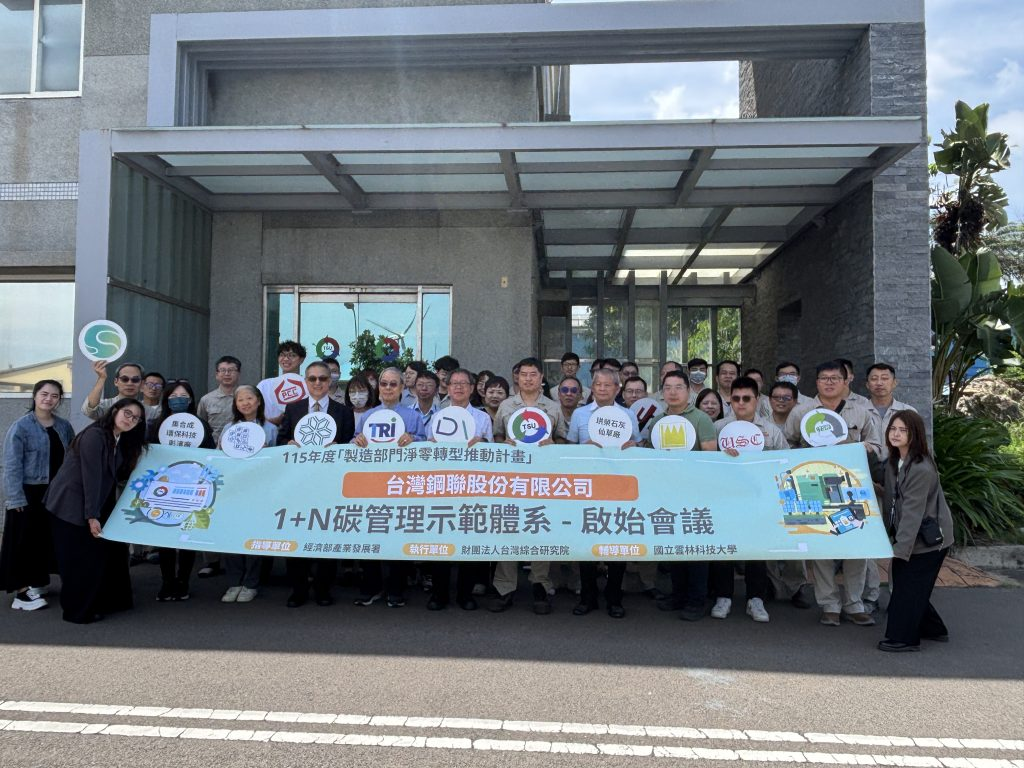
In response to global net-zero transition trends and supply chain carbon management demands, and in alignment with the “Manufacturing Sector Net-Zero Transition Promotion Project—1+N Carbon Management Demonstration System” driven by the Administration of Industrial Development (AID), Ministry of Economic Affairs (MOEA), Taiwan Steel Union Co., Ltd. (TSU) partnered with National Yunlin University of Science and Technology (NYUST) to host this year’s “1+N Carbon Management Demonstration System Kick-off Meeting” today (26th), officially launching greenhouse gas inventorying and deep energy-saving counseling initiatives. Acting as a lead enterprise in its role as a “vein industry” that transforms waste into resources, TSU is connecting upstream and downstream supply chains, driving “artery industry” manufacturers across chemical raw materials, non-metallic mineral products, basic metals, steel, and electrical wires and wiring equipment. This initiative aims to establish carbon inventory and management capabilities, progressively improving the foundation of low-carbon supply chain governance, and moving together toward zero-waste resource circulation and a low-carbon transition.
The kick-off meeting was attended by Chien-Cheng Pan, Deputy Director of AID, MOEA; Tsai-Yi Wu, President of the Taiwan Research Institute; Tsai-Hsiang Lin, Chairman of TSU; Tsong-Lin Shieh, General Manager of TSU; Chao-Hung Chen, Director of the Center for Sustainable Development and Value Management at NYUST; and representatives from TSU’s supply chain partner companies. Participating supply chain manufacturers included TSG Resources Co., Ltd., Chi-He-Cheng Environmental Technology Co., Ltd. (Changbin Plant), Formosa Plastics Corporation (Dongshan Plant), LCY Steel Co., Ltd. (Taoyuan Plant), Lai-Guan Industrial Co., Ltd., Hung-Jung Lime Factory Co., Ltd. (Xiancao Plant), Hsin-Yu Technology Co., Ltd. (Plant 2), and Lu-Chang Chemical Industrial Co., Ltd. (Qingnian Plant), demonstrating the determination of lead enterprises and their supply chains to drive carbon reduction.
Chien-Cheng Pan, Deputy Director of AID, MOEA, stated that by promoting the “Manufacturing Sector Net-Zero Transition Promotion Project,” lead manufacturers guide supply chain partners to jointly establish carbon management foundations, helping the manufacturing sector understand its current carbon emission status and progressively adopt energy-saving and carbon-reduction improvements. He expressed gratitude to TSU for mobilizing supply chain manufacturers to participate in the 1+N carbon management demonstration system in its role as a model enterprise for the circular economy, and thanked NYUST for contributing professional counseling capabilities to help the industrial chain move toward low-carbon and smart transformation.
Tsai-Hsiang Lin, Chairman of TSU, noted that since its establishment, TSU has focused on recycling electric arc furnace (EAF) dust, dedicating itself to converting by-products of the steelmaking process into reusable resources. In recent years, the company has expanded its intake to include three major categories and twelve items of resource-circulating waste, broadening its scope of waste recycling. It is pushing forward with a dual-axis transition—low-carbon and smart transformation—with the vision of “becoming the premier model company for the circular economy in Taiwan.” Since 2012, TSU has established a greenhouse gas inventory system, continuously promoting carbon reduction measures such as process improvements, renewable energy installations, and replacing outdated high-energy-consuming equipment. Its cumulative carbon reduction achievements have decreased emissions by approximately 27% compared to the base year. In the future, the company will continue to utilize carbon inventories, energy management, and smart tools to connect upstream and downstream supply chain data, helping partners identify emission hotspots, progressively reduce Scope 1 to Scope 3 emissions, and build a low-carbon supply chain system.
Chao-Hung Chen, Director of the Center for Sustainable Development and Value Management at NYUST, stated that the center has long been involved in corporate carbon inventories, energy-saving diagnosis, ESG sustainability management, and low-carbon transition counseling. Through a professional consultant team, it helps enterprises extend carbon management operations from basic inventories to energy-saving diagnosis and carbon reduction strategy planning. Moving forward, NYUST and TSU will jointly assist supply chain manufacturers in implementing organizational greenhouse gas inventories, deep energy-saving diagnosis, and carbon management capability building. Based on the industrial characteristics of each plant, concrete counseling recommendations will be proposed covering energy management, process improvement, and material optimization. The initiative aims to achieve a target of saving over 1.2 million kWh of electricity and reducing carbon emissions by more than 1,000 metric tons of $CO_2e$, enhancing the net-zero transition resilience of supply chain manufacturers through the spillover effects of the demonstration system. Through the promotion of this 1+N carbon management demonstration system, TSU will further extend its circular economy and low-carbon transition experience to supply chain partners, helping the industry move from “individual inventorying” to “supply chain co-management” and from “energy-saving improvement” to “low-carbon manufacturing,” creating a low-carbon demonstration model for manufacturing that delivers benefits in circular economy, smart management, and net-zero transition.