



Taiwan Plant Tour: Visiting TSU and TSR: The Frontline of World-Class EAF Dust & Slag Recycling
From July 28 to 30, the global team of Japanese media outlet IRuniverse (MIRU) embarked on a three-day visit to Taiwan.
On July 30, the delegation visited Taiwan Steel Union Corporation (TSU), Taiwan’s only electric arc furnace (EAF) dust recycling company and the country’s leading operator for recycling EAF dust and steelmaking slag. The team also toured Taiwan Steel Resources (TSR), a TSU Group company specializing in the advanced recycling and value-added utilization of steelmaking slag.
The opportunity to organize this site visit stemmed from an online interview conducted about one month earlier with Mr. Sean Lin, Chairman of both TSU and TSR. During the interview, Mr. Lin shared his insights into the current state and future outlook of Taiwan’s EAF dust recycling industry. Following the interview, the MIRU editorial team expressed its interest in observing the facilities firsthand, and Mr. Lin kindly extended an invitation, making this study tour possible.
■ Site Visit 1: TSU – Taiwan’s Largest and the World’s Third-Largest EAF Dust Recycler
In the morning, we visited Taiwan Steel Union Corporation (TSU), Taiwan’s largest electric arc furnace (EAF) dust recycling company.
Established in 1995, TSU was founded through a joint investment by twelve of Taiwan’s leading EAF steel producers. The company was created to ensure the environmentally sound treatment of electric arc furnace dust (EAFD) generated during the steelmaking process, thereby reducing air and water pollution while promoting resource circularity. As a recycling company established collectively by the steel industry to fulfill its environmental and social responsibilities, TSU represents one of the world’s most advanced collaborative recycling models.
Today, TSU processes approximately 90% of all EAF dust generated in Taiwan and has an annual treatment capacity of 200,000 metric tons. With this scale, it ranks as the third-largest EAF dust recycling facility in the world in terms of processing capacity at a single site, making it one of the world’s leading mega recyclers.
Since its establishment, TSU has recovered and treated approximately 2.9 million metric tons of EAF dust, producing around 1.06 million metric tons of crude zinc oxide (CZO). By transforming hazardous steelmaking by-products into valuable secondary resources, the company has established a highly successful circular business model and now plays a pivotal role in supporting resource circulation within Taiwan’s steel industry.
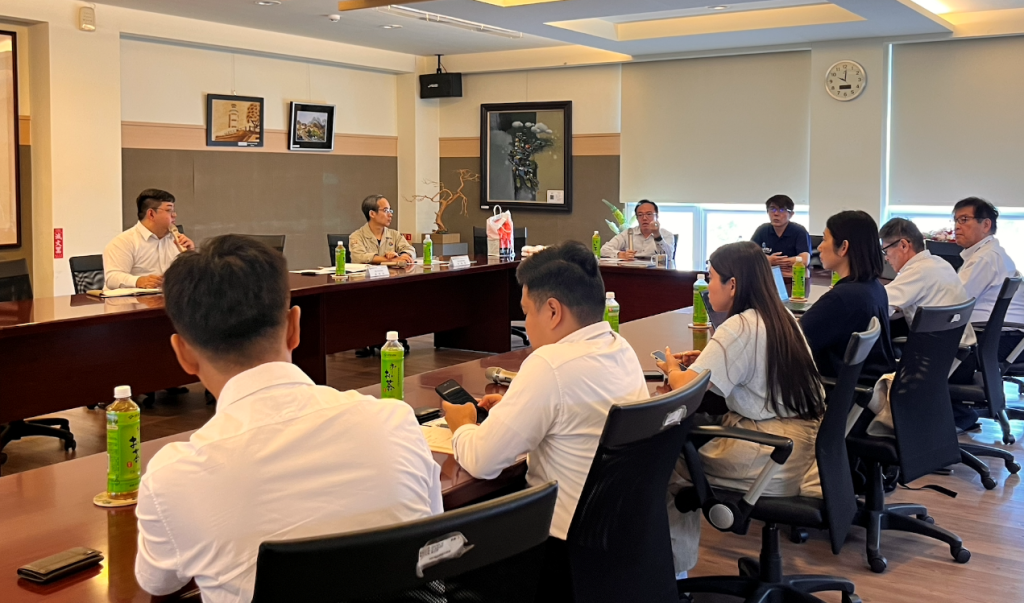
Chairman Sean Lin introducing the company’s operations to the Japanese delegation
ーSupplying High-Grade Crude Zinc Oxide to the Global Market
TSU produces high-grade crude zinc oxide with a zinc content exceeding 56%, making it a premium recycled feedstock that serves as a sustainable alternative to natural zinc ore. Its consistent quality has earned strong recognition from zinc smelters around the world.
Approximately 90% of TSU’s production is exported, with Japan being its largest overseas market. The material is also supplied to zinc smelters across Europe, including Belgium and Poland, as well as throughout Asia, including Thailand and South Korea. As a result, TSU’s crude zinc oxide plays an important role in supporting the global circular economy for zinc resources. The remaining 10% is sold within Taiwan, where it is used as a raw material for zinc oxide in products such as automotive tires.
The company’s commitment to resource efficiency extends beyond zinc recovery. Rotary kiln slag, generated during the recycling process, is not discarded but is instead recycled by TSR, another company within the TSU Group. The processed material is reused as aggregate for concrete and other civil engineering and construction applications.
By recovering zinc from electric arc furnace (EAF) dust while simultaneously utilizing all by-products, the TSU Group has established a zero-emission recycling system that achieves virtually 100% resource utilization. This comprehensive approach to circular resource management is one of the group’s defining strengths.
ーRigorous Environmental Protection and Quality Management: Shared Values with Japanese Companies
The company’s guiding philosophy is management founded on “ethics and integrity.” This principle is reflected in its commitment to the concepts of Corporate Social Responsibility (CSR/ESG) and Urban Mining, whereby electric arc furnace (EAF) steelmakers themselves bear the cost of properly recycling the EAF dust generated by their operations.
Environmental management is exceptionally stringent. The company has achieved 100% resource recovery, realizing both zero emissions and zero landfill disposal. Particularly impressive is the fact that, despite handling highly dispersible EAF dust, every stage of the process—from receiving raw materials to treatment and final product manufacturing—is carried out entirely within enclosed buildings. AIoT-based process management, automated material handling systems, and sealed conveying lines effectively prevent dust emissions, while real-time monitoring ensures precise operational control. During the site visit, the facility was remarkably clean, with virtually no visible dust despite processing large volumes of powdery materials.
The company’s approach to environmental and quality management also closely aligns with Japanese standards. It strictly controls both leachable and total concentrations of the eight regulated heavy metals—including lead, cadmium, mercury, arsenic, hexavalent chromium, copper, barium, and selenium—in accordance with Taiwan’s hazardous waste and product standards, which are broadly based on Japanese Ministry of the Environment regulations and the principles of the Basel Convention.
Discussions with the company’s management also revealed a deep respect for Japanese industry and manufacturing culture. According to the management team, the company’s first plant manager greatly admired Japan’s uncompromising commitment to quality and drew significant inspiration from Japanese manufacturing practices when designing the facility and establishing its quality control systems. Beyond technology, the company shares many of the same core values as Japanese manufacturers, including an unwavering commitment to quality and a strong sense of corporate social responsibility.
■ Site Visit 2: TSR – Transforming Steel Slag into Construction Materials with a Patent-Pending High-Pressure Steam Process
Following lunch, we visited TSR (Taiwan Steel Resources Co., Ltd.), located adjacent to the TSU (Taiwan Steel Union) electric arc furnace (EAF) steelworks. A wholly owned subsidiary of TSU, TSR specializes in the recovery and recycling of steelmaking slag generated by EAF producers.
During the visit, the team received an overview of TSR’s advanced slag recycling technologies and toured the production facilities, where electric arc furnace slag is processed into high-value construction materials.
ーPatent-Pending High-Pressure Steam Curing Technology
The highlight of the visit was TSR’s proprietary high-pressure steam curing (autoclave) process, a patent-pending technology designed to stabilize EAF slag.
One of the major challenges in recycling EAF slag—particularly reducing slag—is the presence of free calcium oxide (CaO) and magnesium oxide (MgO). These compounds react with moisture and expand over time, potentially causing road pavements to heave or concrete structures to crack and delaminate. This volumetric instability has long been one of the biggest obstacles to using EAF slag as a construction material.
Traditionally, the industry has relied on natural weathering (aging), in which slag is stockpiled outdoors and periodically sprayed with water over an extended period. While effective, this method requires large storage areas, lengthy treatment times, and often results in inconsistent product quality.
TSR has developed an alternative approach using high-temperature, high-pressure saturated steam to accelerate hydration and stabilize the slag within a controlled environment. This process significantly reduces the residual expansion ratio to meet Taiwan’s quality standard of below 0.5%, while producing a more consistent material in a much shorter time.
In effect, the technology performs an artificial aging process through pressurized steam curing, converting EAF slag into a stable material suitable for use as a concrete aggregate and cement substitute. According to the company, this pressurized steam stabilization process is currently the subject of a patent application.
Construction of the facility began in 2018, and commercial operations commenced in October 2019. The plant initially operated with three processing lines, but growing demand led to the addition of two more lines in 2021. Today, TSR operates five production lines with an annual slag stabilization capacity of approximately 170,000 tonnes.
The company also operates a pilot ready-mix concrete facility with an annual production capacity of approximately 20 cubic metres, enabling it to evaluate new applications and further expand the utilization of recycled slag in the construction sector.
ーState-of-the-Art Plant Combining Automation and Energy Efficiency
Like TSU’s facility, the entire production process is carried out indoors, with crushing, magnetic separation, screening, steam curing, and product storage all integrated within a single enclosed facility. This fully enclosed design not only prevents dust emissions but also enables stable operations regardless of weather conditions.
One of the most striking aspects of the plant was its high level of automation. Although the initial investment in buildings and equipment is substantial, automated material handling systems and centralized PLC-based process control allow the entire plant to be operated by just two personnel. This not only reduces labor costs but also provides an effective solution to the growing challenge of labor shortages.
At the same time, the company has deliberately avoided fully unmanned operation. Operators continuously monitor the process from a central control room while conducting on-site inspections for safety verification and final quality checks. This balanced approach successfully combines operational efficiency with a high standard of workplace safety, demonstrating that automation and human oversight can complement rather than replace one another.
ーExpanding Applications in the Construction Sector
The stabilized slag produced by TSR is primarily utilized in Taiwan’s domestic infrastructure and construction markets, where it has become a valuable recycled construction material.
One of its principal applications is Controlled Low Strength Material (CLSM), a highly flowable backfill material widely used for utility trench backfilling and filling confined spaces. Unlike conventional concrete, CLSM is engineered to provide sufficient strength for stability while allowing for future excavation when necessary, making it particularly suitable for underground infrastructure projects.
The slag is also used in non-structural concrete and general backfill applications. Owing to its relatively high specific gravity (approximately 2.2–2.3, compared with 1.5–1.6 for ordinary soil), it is well suited for projects requiring additional weight, such as foundation materials and anti-uplift or anti-overturning applications.
Furthermore, TSR’s recycled slag has been certified under Taiwan’s Green Building Materials Label administered by the Architecture and Building Research Institute (ABRI) of the Ministry of the Interior. In 2024, the material was officially approved for use as a foundation and ground improvement material in public construction projects.
TSR’s success in transforming electric arc furnace (EAF) slag—once regarded as a waste requiring disposal—into high-value construction materials represents one of Taiwan’s most noteworthy examples of the circular economy in practice. Its proactive efforts to develop new applications, particularly in products such as CLSM, demonstrate how industrial by-products can be converted into valuable resources, offering a compelling vision for the future of sustainable resource recycling and the circular industry.
■ Reflecting on the Visit: “Resources Are Finite, Creativity Is Infinite!”
At the conclusion of the visit, CEO Mr. Tanamachi, representing the Japanese delegation, was invited to sign the company’s guestbook. Mr. Sean told that he was the first Japanese visitor ever to do so. The words he wrote were: 資源有限創意無限! (Resources are finite, creativity is infinite!)
At the frontline of Taiwan’s recycling industry, witnessing such a high standard of environmental ethics and relentless pursuit of technology, we felt here is a place that embodies those words.
謝謝! (Thank you, Taiwan!)